Which plan fits a salon
We have three plans. See which fits, or ask for a free quote.
A busy salon at $25,000 a month on cards? That is about 300 visits a month at $85 each. Prime49 is the place to start: the service menu shows a cash price and a card price, and you get a payout each month, with no long-term contract.
Want clients who pay by card to cover the fee? Edge, our cash discount plan, prints both prices on the service menu, so the client sees them before booking. A lower cash price is a discount, not an added card fee under Texas law. Needs at least $10,000 a month in card sales.
Want one price on every service? Traditional processing, priced interchange plus, leaves your menu as it is. Each statement shows the card networks' charge and the fixed amount on top. Needs at least $10,000 a month in card sales.
What card fees cost a salon
Here's the math behind the number at the top: the card fee comes out of the whole ticket, meaning the service, the retail and the tip. A salon taking $15,000 a month on cards at about 3% pays about $5,400 a year in fees. Your statement shows your real figure.
On Edge, the card price on the service menu covers that fee, so the salon keeps its full service price.
One visit, from chair to checkout
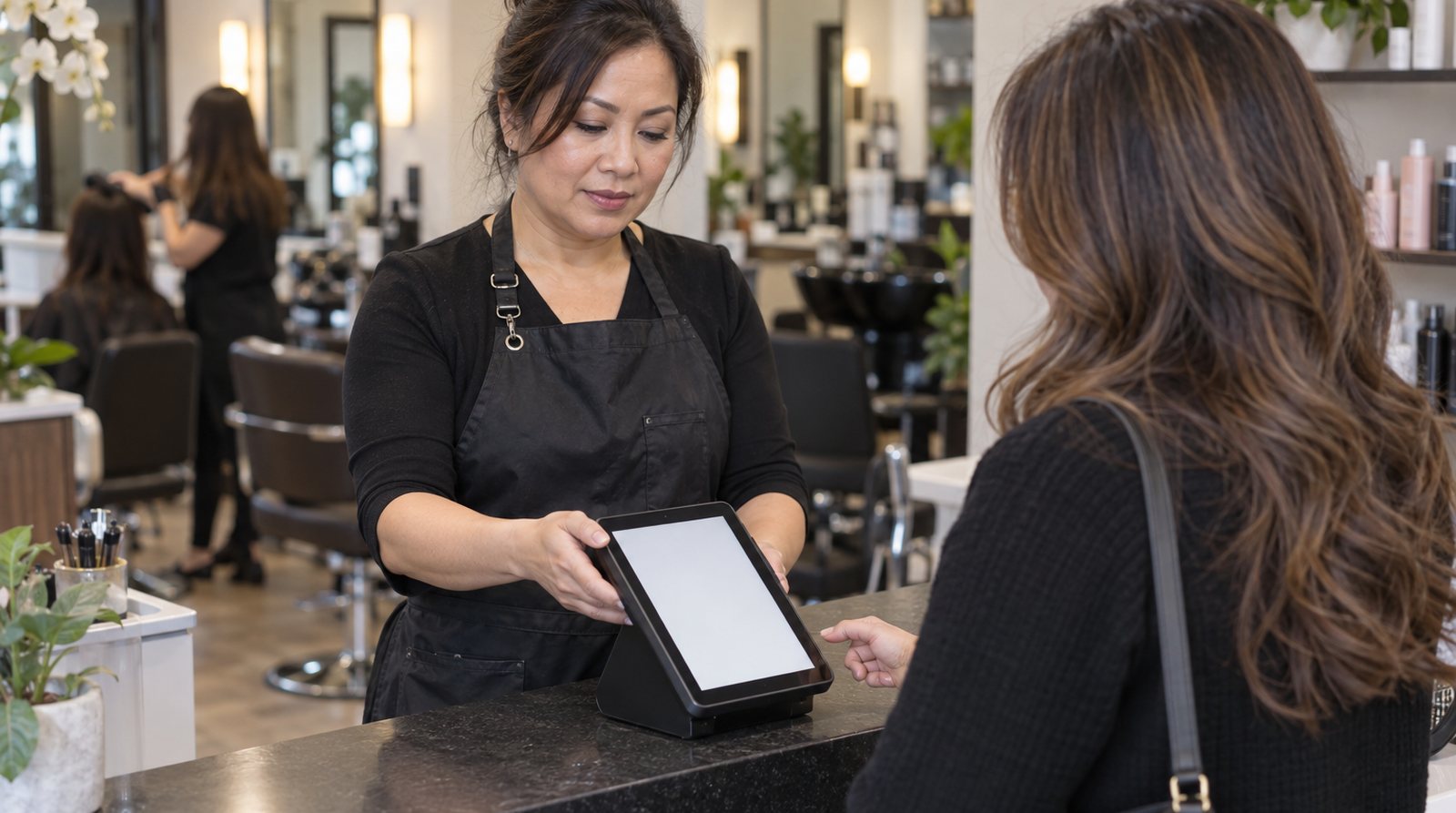
A client books a cut and color online for $120. The booking page shows your no-show policy, and the client checks the box before the booking goes through.
After the appointment, the client buys a $24 bottle of shampoo and adds a $20 tip for the stylist on the card. The haircut is not on the Comptroller's list of taxed services. The shampoo is a retail sale, so at a local rate of 8.25% it carries $1.98 in tax. The client taps a card for $165.98.
At about 3%, the card fee on that sale is about $4.98. About 60 cents of it is the fee on the tip.
Say the stylist is an employee. On payday, the stylist gets the $20 tip, or $19.40 if you take out the 3% fee on it. The next sections show the rules behind each step.
Card tips for your staff
The U.S. Department of Labor says that when a tip is charged to a card and you pay the card company a percentage, you may pay the employee the tip less that percentage. You may not take out more than the fee.
It also says the tip is due no later than the regular payday. You may not hold it while you wait for the card company to pay you.
For staff paid a tipped wage, the Department of Labor says the cash wage must be at least $2.13 an hour under federal law.
What staff report to the IRS
The IRS says tips paid by credit card, debit card or a mobile payment app count as cash tips. It says all tips employees receive are income, subject to federal income tax and generally to Social Security and Medicare taxes.
Employees keep a daily tip record. They report cash tips to the employer, unless they total less than $20 in a month from that employer. The IRS guide for salons, Publication 4902, says customer receipts and credit card slips can back up that record.
Tips for the stylist who rents a booth
The IRS says hair stylists may get tips straight from customers or through other platforms. It says tips received by self-employed workers are income, reported on Schedule C, and they carry self-employment tax.
Publication 4902 says a booth renter runs an independent business. It lists signs of that: a key to the shop, your own hours, your own products, your own phone number and business name, and your own prices. Without these, it says you are likely an employee of the business that provides the space.
It also says a booth renter may need to make estimated tax payments, since no one withholds tax from that pay.
No-show fees
Visa's guide for merchants says cancellation terms must be disclosed before purchase to be relied on. It says a fee must match the policy and timing the customer was shown.
When a booking is reserved with a card, it says to keep your cancellation terms and proof the no-show fee was charged correctly. So keep the booking record that shows the client saw the policy, and the date and time of the missed visit.
Texas tax on services and products
The Texas Comptroller lists 16 kinds of taxable services. Under personal services, it names massage parlors, Turkish baths and escort services. Hair care is not named.
The Comptroller's sales tax page says Texas taxes all retail sales of most goods. That covers the shampoo, styling products and tools you sell at the front desk. Ring them up on their own lines, so the tax lands only on the products. Ask the Comptroller or your tax adviser how this applies to what you sell.
Related reading: credit card processing for gyms and studios, how mobile card readers work for a stylist on the go, and what a chargeback is.
Which plan fits your salon? Ask for a free quote and we tell you.
Get your free quote →Not sure what fits? Answer a few questions and get a custom plan.