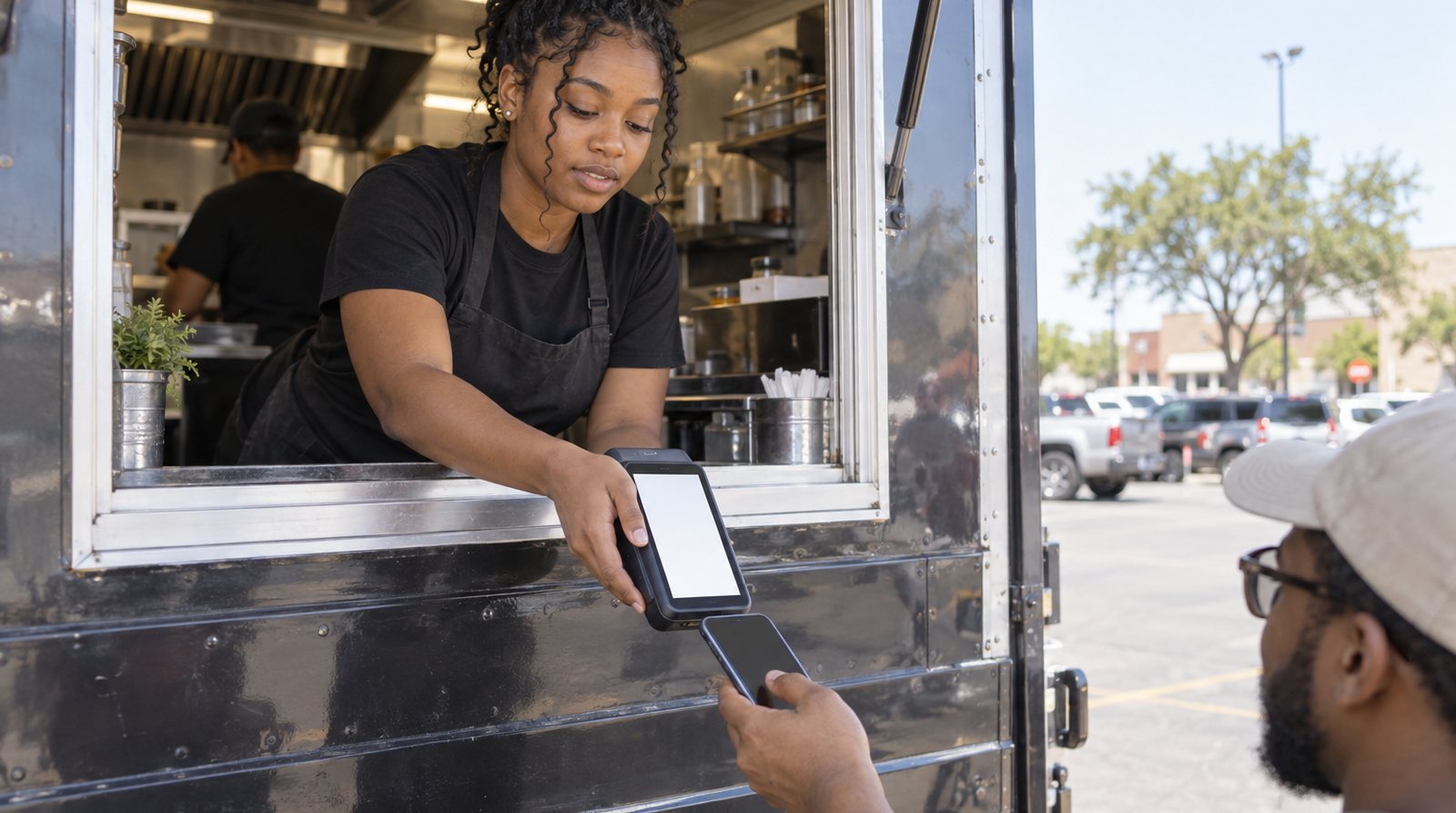
Which plan fits a food truck
We have three plans. See which fits, or ask for a free quote.
A busy truck clearing $25,000 a month on cards? Start with Prime49. The menu board shows a cash price and a card price, you get a payout each month, and there is no long-term contract.
Want the card price on the board to carry the fee? Edge, our cash discount plan, lists both prices on the board, so a customer sees them before ordering at the window. Cash customers pay the lower one. A lower cash price is a discount, not an added card fee under Texas law, but a fee added at the window would be. Needs at least $10,000 a month in card sales.
Want one number per item on the board? Traditional processing, priced interchange plus, keeps one price. Your monthly statement breaks out the card networks' cost and the fixed add-on. Needs at least $10,000 a month in card sales.
What card fees cost a truck
At an example rate of about 3%, card network fees and the processor's charge together, a $15.70 order costs about 47 cents to take by card. Sell 1,600 orders like that and the month is about $25,000 on cards, with about $750 of it gone to fees. Your real total is on your monthly statement. Your quote shows your real rate.
On Edge, the card price on the board carries those cents, so the truck keeps the full menu price.
One Saturday at the window
You park at a brewery lot for lunch. A customer orders a $12 brisket plate and a $2.50 canned soda, and both are taxable. At an 8.25% rate the tax is $1.20, so the customer pays $15.70 and taps a card.
At 1 PM the signal drops. Your reader switches to offline mode and keeps taking card payments, then sends those sales when the signal comes back. If one of those cards declines, you may not collect that sale.
That evening you settle the day's sales. The next sections show the Visa and Texas rules behind each step.
Your reader rides with you
The card reader is the one tool you carry to every stop. Read the chip whenever the card has one. Visa's merchant guide says that when a chip card is swiped or keyed in instead, you may be held responsible for certain fraud.
Our guide to mobile card readers covers what to check before you buy one.
When the signal drops
Visa says that if your terminal is offline or the authorization system is unavailable, you should follow your acquirer's fallback steps. It says never to assume approval without confirmation.
The guide lists two offline mistakes as reasons for an authorization dispute: a sale that needed online approval run offline past the allowed limits, and a sale completed offline after the card was declined online. Ask your processor what your offline limits are.
Offline mode has a catch
Some readers keep taking card payments with no signal. Visa's guide for merchants says that completing a declined sale puts you at risk of losing the funds. It lists a sale completed offline after an online decline as one cause of authorization disputes.
Other processors set their own rules, so ask yours before you rely on offline mode.
Settle the day's sales
Visa says to settle sales promptly, ideally on the same day. Settling sends the day's card sales in for payment. Check that your offline sales went through before you close out.
Get the total right
Visa lists a wrong amount as a reason a customer can dispute a charge, including a tip added the wrong way. It says to let customers see and confirm the final amount before they pay, and to fix a mistake right away with a reversal or refund.
Texas tax on food from a truck
Texas Rule 3.293 defines a mobile vendor as a person who sells food from a motor vehicle, push cart or any other form of vehicle. It lists all food ready for immediate consumption sold by caterers, mobile vendors or restaurants as taxable.
What else is taxed at the window
The same rule lists soft drinks, candy and ice as taxable. Soft drinks include canned and bottled teas and coffees with sweetener. Drinks with milk, and juices that are more than 50% fruit or vegetable juice, are not soft drinks.
Snacks sold in single-serving packs, labeled as one serving or under 2.5 ounces, are taxable. Bakery items are taxable when sold heated or with plates or utensils.
Which rate applies
The state sales tax is 6.25%. Cities and other local areas can add up to 2%, for a top combined rate of 8.25%. The Comptroller's rate locator looks up the rate by address.
Ask the Comptroller or a tax adviser which local rate applies where you park.
Related reading: taking credit card payments at a market stall, chargebacks and cash discount vs surcharge vs dual pricing.
Which plan fits your truck? Ask for a free quote and we tell you.
Get your free quote →Not sure what fits? Answer a few questions and get a custom plan.