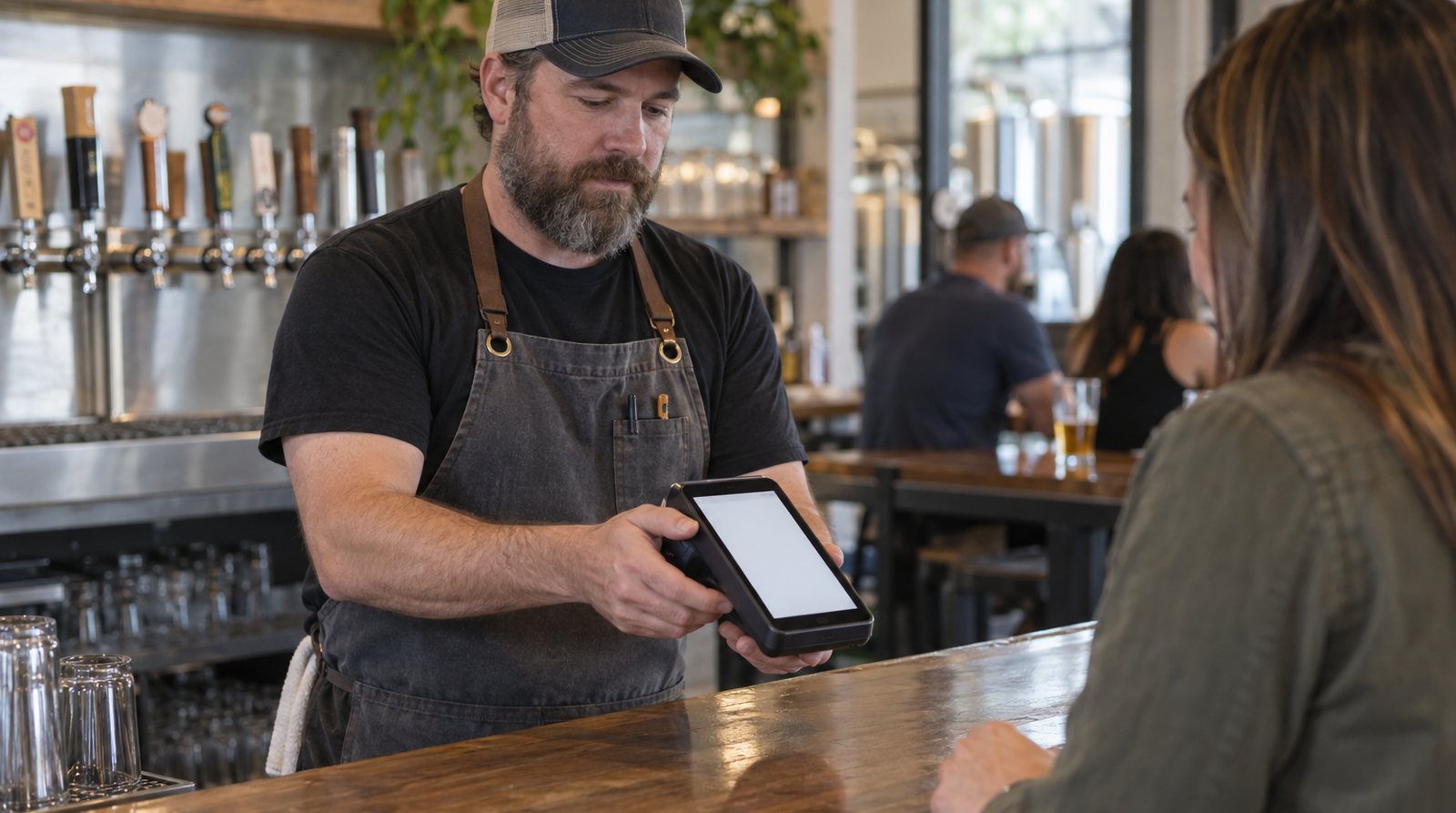
Which plan fits a bar or brewery
Count a normal month of tabs, card sales only. That one number points you to a plan, and the free quote fills in the rest with your real statement.
A busy bar or taproom. Weekend crowds and event nights can push you to $25,000 or more a month in card sales. That is the line for Prime49: approved businesses get a payout every month.
A neighborhood spot with a cash crowd. Regulars who pay cash at the rail can get a lower price on Edge, our cash discount plan. Put both prices on the chalkboard so nobody is surprised when the tab closes. It needs $10,000 a month in card sales.
A brewery that wants one price per pint. Traditional processing, priced interchange plus, keeps a single price on the menu and splits the network cost from our amount on each statement, so you can check both. It also needs $10,000 a month in card sales.
Traditional processing is the fourth choice, with the same $10,000 a month in card sales floor. Run a bar and a taproom, or two locations? Note it on the form and one quote covers both. No plan ties you to a long-term contract.
What card fees cost a bar
A bar pays its card fee on the full amount that runs through the reader, and that includes the tip. Picture 20,000 dollars of card sales in a month. If network costs and the processor's share come to about 3 percent, as a made-up example, the bar hands over 600 dollars that month and 7,200 dollars over a year.
Late rounds make tabs bigger, and every extra drink adds a little to the fee. Your statement shows your true number.
Holds on a tab
Visa's merchant guide says that when you place a hold, you do not include extra amounts for damage, theft, insurance or tips.
The guide says a hold, which it calls an estimated authorization, needs three things. The estimate has to be realistic. You tell the customer the amount is estimated and may change. And you leave out extra amounts for potential damage, theft, insurance or tips. If the final amount ends up above your estimate, the guide says you can ask for more with an incremental authorization, but only for what is needed to cover the final amount.
So the hold is a guess at the drinks, not the tip. Tell the guest when you open the tab: "We hold a small amount now, and the final charge may be different."
One Saturday night, from open tab to batch
A group of four opens a tab with one card. Your system holds 45 dollars, a realistic guess at what four people will spend. Nothing in that hold is for a tip.
They order drinks and food. At the end of the night the tab is 42 dollars, tax included. The guest adds a 20 percent tip, which is 8 dollars and 40 cents. The final charge is 50 dollars and 40 cents.
Using the same made-up 3 percent, that 50 dollar and 40 cent charge costs the bar about 1 dollar and 51 cents. Roughly a quarter of that, about 25 cents, comes from the tip alone.
Two more guests sign paper slips and write their tips by hand. Someone keys those in before the batch goes out tonight. Here is the rule behind each of those steps.
Tips and the IRS
The IRS says tips paid by credit card count as tips for reporting. It says employees must report tips to their employer by the 10th of the month after they received them.
The IRS also says employees with 20 dollars or more in tips in a month report them to the employer. Under 20 dollars in a month from one job is not reported. Employees must keep a daily tip record. They can write the tips in a diary or keep copies of documents that show them, such as card charge slips. The same IRS publication says to report cash, check, debit and credit card tips.
Bigger bars have one more job. The IRS instructions for Form 8027 say an employer who runs a large food or beverage establishment must file it. The IRS defines that as a place where tipping is customary and the employer normally had more than 10 employees on a typical business day in the year before. Line 1 asks for the total tips shown on charge receipts for the year, so your card batches are the source. Ask your tax adviser if this applies to you.
Tax on tips in Texas
The Texas Comptroller says no sales tax is due on a voluntary gratuity the customer pays on top of the price of the meal. It says mandatory gratuities over 20 percent are taxable. Ask the Comptroller or your tax adviser how this applies to your bar.
Private events and big groups
Bars that host birthday parties, watch parties or a brewery buyout often add a set gratuity to the final bill. The Comptroller's guide lets that charge skip sales tax only when it clears three bars:
- Keep it at 20 percent of the bill or under. Go higher and the whole gratuity is taxed.
- Put it on a line of its own. Call it a tip or a gratuity on the check.
- Give all of it to the servers. The money goes to the staff who work the event.
A tip a guest adds on their own is never taxed. If your event contract is unclear, ask the Comptroller before the party.
Tax on beer, wine and mixed drinks
The Texas Comptroller's mixed beverage page says mixed beverage permit holders owe both mixed beverage gross receipts tax and mixed beverage sales tax on alcohol sales. It says only sales tax applies to sales of wine, beer and ale for holders of a wine and beer retailer's permit or a beer retail dealer's on-premises license.
It also says you need a sales tax permit whether or not you sell food or other items. Brewers with a self-distribution permit file a monthly Alcohol Sales Report. Your permit decides which taxes you owe, so check with the Comptroller.
When the amount on the tab is wrong
A tip typed in wrong is a common reason a guest disputes a charge, says Visa's dispute guide. Think of a 5 dollar tip entered as 50, or 39 flipped into 93.
To answer one, you show the record of how the final charge was reached and when the guest saw it. File each signed slip with its night's batch. Visa also tells merchants to coach staff to stop and double check any amount that changed after the first swipe.
Common traps behind the bar
- Holding for the tip. Visa says a hold leaves out tips.
- Paper tips left for tomorrow. Key them in before the batch closes.
- A gratuity over 20 percent. The Comptroller says it is taxable.
- No record of the final amount. Keep slips and system records together.
- Waiting to settle. Visa says delayed settlement can confuse customers and raise the risk of disputes.
Close out every day
Visa's guide says to set your terminal to settle transactions daily, or to start settlement by hand at the end of each business day. A bar that closes at 2 AM should still close its batch every day. One person can enter the paper tips, check the tab count against the drawer, then run Close of Day.
Running a different kind of business? See credit card processing for Texas grocery stores and nonprofits.
A bar or brewery takes cards by the tab, so three rules matter most: holds, tips and tax on tips.
Ask how VMS would run your tabs →Not sure what fits? Answer a few questions and get a custom plan.