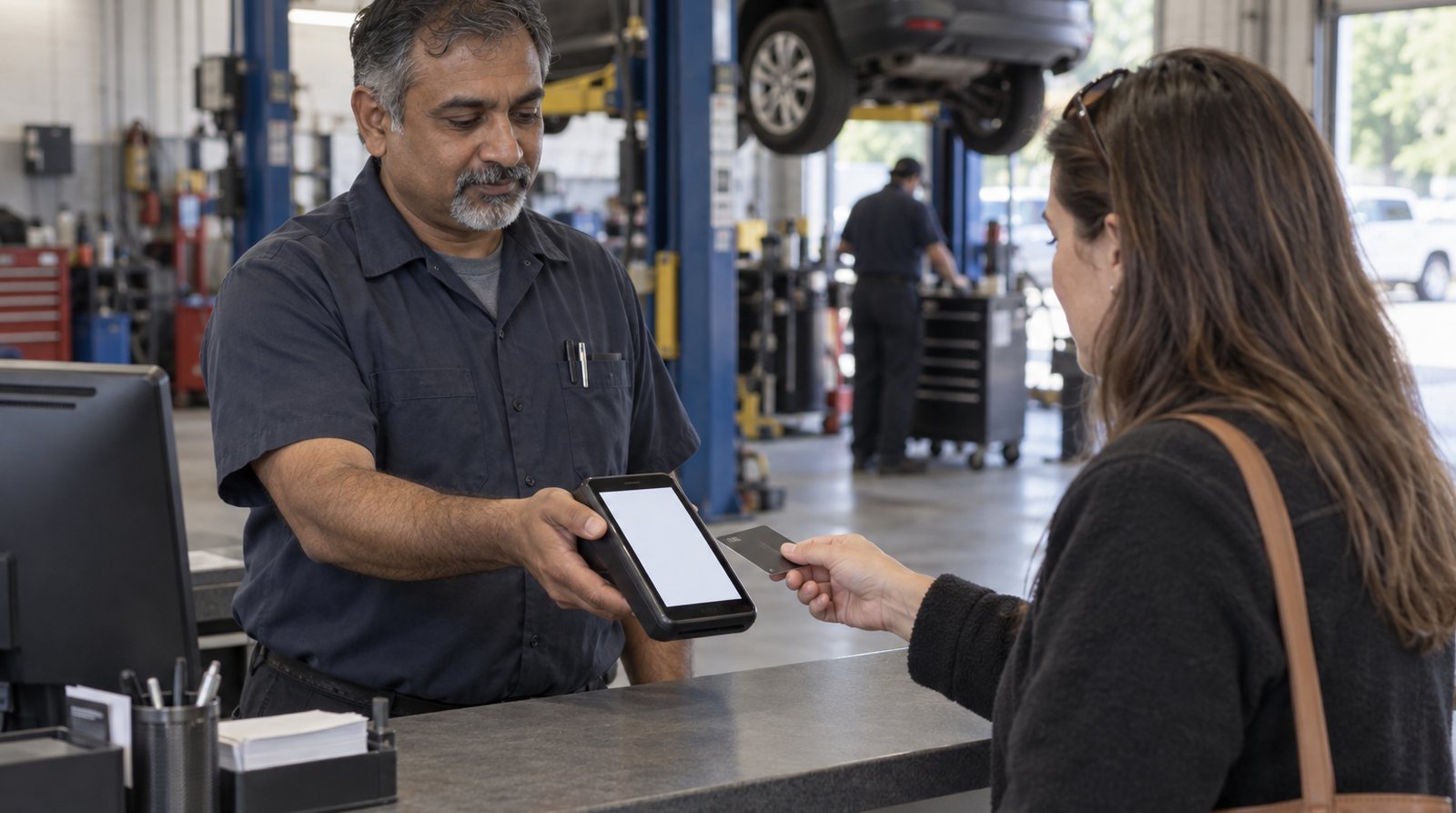
Which plan fits a repair shop
We have three plans. See which fits, or ask for a free quote.
Taking $25,000 or more a month by card? Eleven $2,400 repairs a month clears that line. Start with Prime49. The estimate shows a cash price and a card price, you get a payout each month, and there is no long-term contract. Approval depends on your shop and its setup.
A smaller shop tired of paying the fee on big tickets? Edge, our cash discount plan, writes both prices on the estimate. The customer sees the card price before saying yes to the work, so the card price carries the fee on a $2,400 job. A lower price for cash is not a surcharge under Texas law. Needs at least $10,000 a month in card sales.
Billing fleet accounts and want one price on every repair order? Traditional processing, priced interchange plus, keeps a single price. Each month your statement lists what the card networks charged and the fixed amount on top. Needs at least $10,000 a month in card sales.
What a big ticket costs in card fees
Here's the math behind the number at the top: at about 3% in card fees, a $2,400 repair costs about $72 to take by card. Ten repairs like that a month cost about $8,640 in fees over a year. Your own numbers are on your monthly statement.
On Edge, the card price on the estimate carries that fee, so the shop keeps the full repair price.
One repair, from drop-off to pickup
A customer drops off a car for squeaky brakes. You write up $180 in labor and $120 in pads, plus tax on the pads, and tell the customer it is an estimate that may change. They sign the work order.
On the lift, the tech finds a leaking caliper. That adds $140 in parts and $60 in labor. You text the customer the new total, and they text back yes. That text goes in the file with the work order.
The final invoice lists $240 in labor and $260 in parts. Tax applies to the $260 in parts only. At 8.25%, that is $21.45, so the customer pays $521.45 and taps a card.
The next sections show the Visa and Texas rules behind each step.
Estimate holds
Visa's merchant guide says an estimated authorization is for when the final amount is not known. The estimate must be realistic, and you must tell the customer it is an estimate and may change. You must not add extra amounts for potential damage, theft, insurance or tips.
Before you count on estimate holds, ask your processor whether your terminal supports estimated and incremental authorizations.
When the bill grows
Visa says that when the final amount ends up higher than your estimate, you can ask for an incremental authorization. Use the same transaction ID, include the incremental indicator, and ask only for what is needed to cover the final amount.
Skipping that step is on Visa's list of reasons for an authorization dispute: a higher amount submitted than the estimate, without proper incremental authorization.
Get the yes in writing
Visa lists a service that was poorly done, or did not match the agreed scope, as a reason a customer can dispute a charge. It says to keep records such as receipts, customer acknowledgments and confirmation emails. It also says spoken explanations and internal notes do not replace what the customer was shown.
At a repair counter, that is a signed work order with the scope, plus the customer's written yes for any added work. Visa also says to ask the customer, in writing when you can, to confirm the service was received in good condition, and to answer complaints right away and write down what you did.
Post your policy where the customer pays
Visa says a policy for in-person sales can be printed on the front of the receipt near the signature line, posted where the customer pays, or printed on the back of the receipt with space for a signature or initials.
Put your warranty and refund policy on the work order and at the counter, so the customer sees it before paying.
Large tickets
Visa says that when you know the full amount and it is over your floor limit, you must get approval for the exact amount before you complete the sale. A floor limit is the most a sale can be without online approval from the card's bank.
Visa adds that a terminal letting a sale go through without that approval does not protect you from a dispute. Ask your processor how your floor limit is set.
Texas tax on repair labor and parts
The Texas Comptroller's publication on motor vehicle repairs, remodels and maintenance says there is no sales tax on the labor to repair a motor vehicle. Its examples are the labor to repair or replace a tire, battery, muffler or shock absorber. Parts used in repairs are taxable.
The state sales tax is 6.25%. Cities and other local areas can add up to 2%, for a top combined rate of 8.25%.
One price or itemized invoices
How you write the invoice changes who pays the tax on parts.
- One price for parts and labor. The Comptroller says you do not collect sales tax from the customer. You pay it to your supplier when you buy the parts. Its example is a $69.95 oil change.
- Parts and labor on separate lines. You collect sales tax on the parts, and the labor is not taxed. You can give your supplier a resale certificate instead of paying tax on the parts. Its example is $20 in labor and $49.95 for oil and a filter, with tax on the $49.95 only.
If you collect tax by mistake, the Comptroller says you still send it in on your return.
Shop supplies and tools
The Comptroller lists shop rags, floorboard covers, solvents, masking tape, sandpaper and polish as consumable supplies. List a separate charge for them, and you collect tax on the total of parts and supplies. On a one-price invoice, you pay tax on them when you buy them.
Tools and equipment are yours to use. You pay tax when you buy them, and you may not collect sales tax from customers on any charge for them.
Warranty and recall work
The Comptroller says parts and labor a manufacturer supplies under a warranty or recall are not subject to sales tax. Keep records that show the work was done under that warranty or recall.
Under an extended warranty, sales tax is due on the parts the manufacturer's warranty does not cover.
Remodels and accessories are taxed in full
The Comptroller says sales tax is due on all parts and labor to remodel a vehicle, such as a lift kit, a van turned into a camper, or added engine performance. The same goes for selling and installing accessories such as car stereos, amplifiers and alarm systems.
Replacing a broken factory stereo is a repair, so only the parts are taxed. Check your invoices with the Comptroller or a tax adviser.
Related reading: pre-authorization, chargebacks and cash discount vs surcharge vs dual pricing.
Ask for a free quote, and we tell you which plan fits your shop.
Get your free quote →Not sure what fits? Answer a few questions and get a custom plan.