What you get
Your customers see a cash price and a card price before they pay, and they pick how to pay. Cash buyers get the lower price. The card price covers the card fee.
Prime49 uses this two-price setup. Businesses with $25,000 or more a month in card sales get a payout every month, based on their own card sales that month. Prime49 is the only VMS plan that pays monthly. It comes with free point of sale equipment, and there is no long-term contract.
Every VMS plan comes with free point of sale equipment.
How it looks at your counter
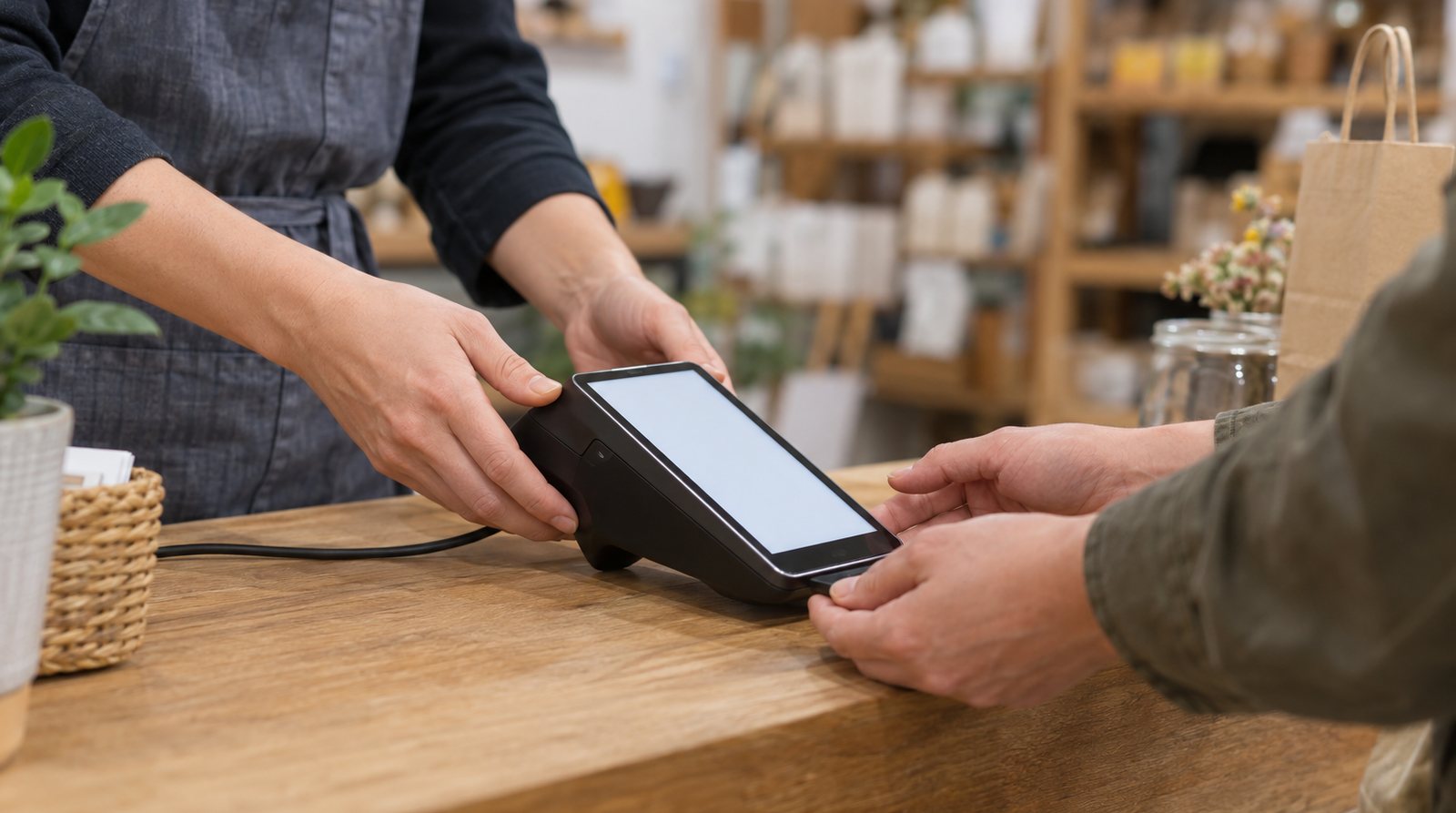
Both prices go on your sign, menu or tag. The receipt shows the price the customer paid. You see how checkout will look and approve it before anything goes live.
On a sign
Put the two prices side by side, in the same size and the same type. Do not tuck the card price into small print.
Keep the words plain. A sign with "Cash" on the left and "Card" on the right says it all. Add one short line, such as "Pick how you pay at the counter."
Hang it where people see it before they order. The door, the counter and the register are good spots.
On a menu
Print two columns, one for cash and one for card, so a guest sees both prices next to each dish. Guests choose how to pay before they order, so they know the total before the check arrives.
If your menu changes often, set it up once with the two columns and update both numbers whenever a dish changes.
On a shelf tag
Put the cash price and the card price on the same tag. Keep them on one line, or one above the other, so nobody has to hunt for the second number.
Do the same for sale items. If the cash price drops, the card price drops with it, and the tag shows both new numbers.
On the receipt
The receipt lists each item and the total the customer paid. A cash receipt shows the cash total. A card receipt shows the card total. Look at a test receipt of each kind before you go live, and make sure the words match your sign.
A worked example
Say a customer buys two sandwiches and a drink. Your sign shows $40 for cash and $41.20 for card. This is an example only, not a VMS price.
A customer who pays cash hands over 40 dollars. A customer who pays by card pays 41 dollars and 20 cents. The 1 dollar and 20 cents is the part of the card price that goes toward the card fee.
Now picture 50 card sales like that in one day. That is 60 dollars in card price difference for the day (50 sales times 1 dollar and 20 cents). The math is simple, so you can show it to a new hire in a minute.
What to say at the counter
Say the two prices out loud before the customer reaches for a card. Then ask which way they want to pay. Here is a script your team can use:
- "That comes to 40 dollars cash or 41 dollars and 20 cents on a card. Which works for you?"
- If a customer asks why there are two prices: "We show both so you can pick. Cash is the lower one."
- If a customer wants to switch: "Sure, I can ring it up as cash."
Train every person who works the register the same way. Practice the lines with a teammate for five minutes before opening day. A calm, friendly answer helps.
What customers ask
Is the card price a mistake? No. Point to the sign. Both prices are there on purpose, and the customer picks.
Can I pay cash and get the lower price? Yes. Cash is always the lower one.
Why two prices at all? Taking a card costs the business a fee. Two prices let each customer choose how to pay.
A short, kind answer works better than a long one.
Which businesses it suits
Two prices work well where the customer sees a price before they pay. That includes:
- Restaurants and delis with a printed menu.
- Shops with shelf tags.
- Salons, gyms and auto shops with a posted price list.
- Food trucks with a menu board at the window.
A business that quotes each job by hand can still use it. Each quote just carries two totals, one for cash and one for card.
Before you go live
- Pick the cash price and the card price for each item.
- Update the sign, the menu or the tag so both prices show.
- Teach your staff the counter script.
- Check a cash receipt and a card receipt on a test sale.
- Approve how checkout looks. Nothing goes live until you do.
Which plan fits
We have three plans. See which fits, or ask for a free quote.
Ringing up $25,000 or more a month on cards? Start with Prime49. Your sign, menu or tag carries a cash price and a card price, and you get a payout each month, with no long-term contract.
Tired of paying the fee on every sale? Edge, our cash discount plan, shows both prices. Customers choose how to pay before they buy, so no fee shows up after the sale. Needs at least $10,000 a month in card sales.
Want one price per item? Traditional processing, priced interchange plus or flat rate, leaves your prices alone. On interchange plus, the statement shows the card network's cost and our markup on separate lines. Needs at least $10,000 a month in card sales.
Dual pricing and the law
A lower price for paying cash is not a surcharge in Texas (section 604A.001(5)). A fee added only for card payers can count as a surcharge, and Texas law still bars a surcharge on credit cards (section 604A.0021).
The full rules are on our Texas card fee law page.
Find the plan that fits your business.
Get your free quote →Not sure what fits? Answer a few questions and get a custom plan.